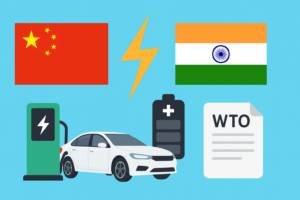

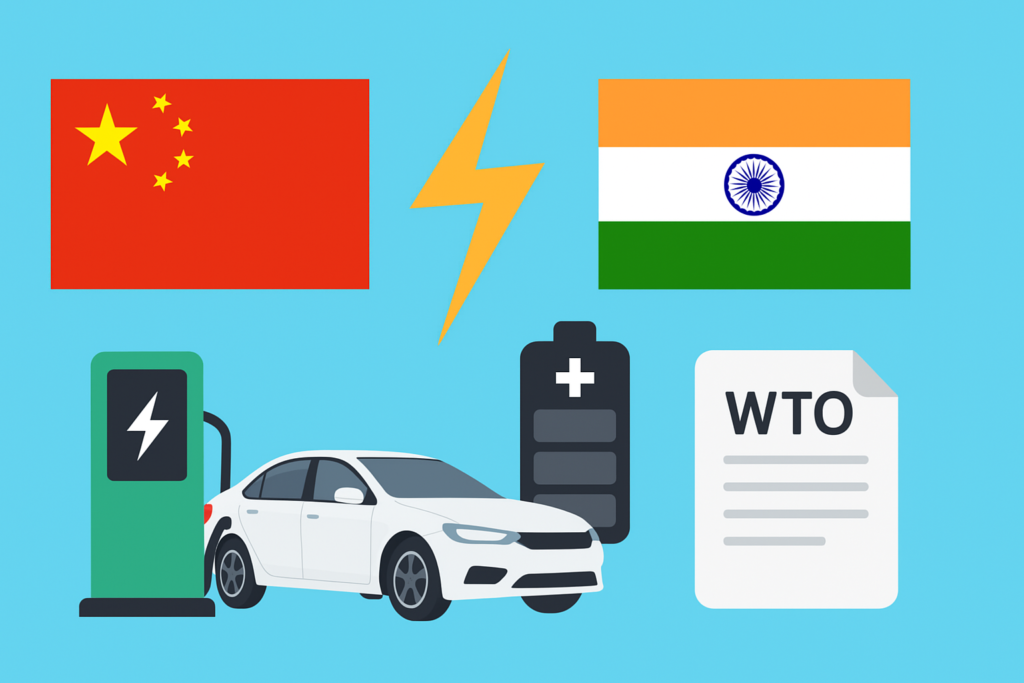
China has officially filed a complaint at the World Trade Organization (WTO) against India, alleging that India’s electric vehicle (EV) and battery subsidy programs under schemes like the Production Linked Incentive (PLI) violate WTO rules.
According to reports, Beijing claims that India’s incentives favor domestic manufacturers and discriminate against imported products, thereby breaching global trade obligations.
What Is China Objecting To?
China’s Ministry of Commerce said that India’s EV and battery policy—including
financial incentives for local manufacturers—is tied to domestic content requirements.
These policies, China argues, make it difficult for foreign (especially Chinese) EV and battery producers to access the Indian market fairly.
India’s Response
India’s Commerce Ministry has said it will review China’s complaint carefully. Under WTO rules, both nations have 30 days to hold consultations before a formal dispute panel is established.
Officials have indicated that India’s PLI and EV support measures are compliant with international norms and essential to building a sustainable local industry.
The Bigger Picture
This dispute comes at a time when both nations are competing for leadership in EV manufacturing and battery supply chains.
Experts say this could become a landmark trade case, shaping how countries design green energy incentives in the future.
If the WTO rules in favor of China, India might be required to amend or withdraw certain subsidy provisions.
If not, the decision could strengthen India’s industrial policy strategy for EV growth.
Timeline of Events
October 15, 2025 — China officially requests consultations at the WTO over India’s EV subsidies.
October 20, 2025 — The WTO circulates the request to its members.
October 21, 2025 — India confirms it will review the complaint and prepare its response.
Expert Views
Trade experts say this move could increase tensions between the two Asian giants in the global EV market.
It also underscores how clean-energy policies are becoming new battlegrounds for trade competition.
What Happens Next?
- The WTO will facilitate 30-day consultations between India and China.
- If no resolution is found, a dispute panel may be set up.
- The ruling could take several months—or even years.
- Meanwhile, India is expected to continue offering domestic EV incentives.
Why It Matters for the EV Industry
India’s EV mission 2030 aims to reduce oil dependence and boost clean transportation.
Domestic production incentives have attracted major companies like Tata Motors, Ola Electric, and Reliance New Energy.
If WTO pressure forces India to scale back subsidies, private investment and local manufacturing could be affected—giving foreign competitors an edge.
Conclusion
This WTO case is more than a trade issue—it’s a battle for control over the future of green mobility.
Whether India adjusts its subsidy policies or stands firm will determine its global position in the EV and battery ecosystem.