


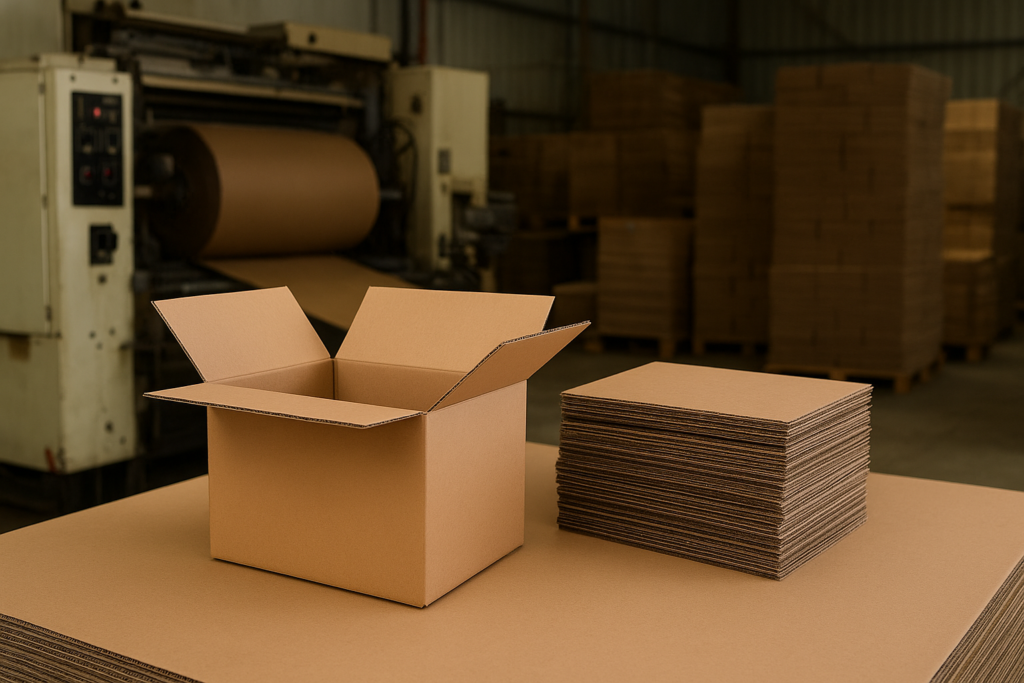
Corrugated boxes are the unsung heroes of Indian commerce. Every e-commerce seller, pharma company, FMCG brand, electronics manufacturer, and kirana wholesaler ships products in them. Demand keeps growing with online shopping, D2C brands, food delivery, and organized retail. If you like the idea of a tangible, steady, B2B business with repeat orders, a corrugated box unit can be a solid bet.
Below is the complete roadmap—market, licensing, machinery, team, costing, quality control, sales, and scale-up—presented as if we’re setting it up together.
1) Understand What You’re Really Selling (and to Whom)
A “corrugated box” isn’t one generic product. You’ll sell a solution that protects goods at the lowest landed cost. Buyers care about:
- Strength vs cost: Enough compression/stacking strength without over-spec.
- Consistency: Same quality, same dimensions, every time.
- On-time delivery: Delays can shut their packing lines.
- Print & branding: Clean logos, barcodes, handling marks.
- Moisture resistance: Especially for coastal/rainy regions and cold chains.
Main customer buckets:
- E-commerce & logistics (3-ply/5-ply shipper boxes, die-cut mailers)
- FMCG/food & beverage (branded printed cartons, moisture control)
- Pharmaceuticals & cosmetics (tight tolerances, neat printing)
- Electronics & appliances (heavier 5-ply/7-ply)
- Auto & engineering (custom inserts, high BF paper)
- Agriculture (fruit/veg crates, ventilated die-cuts)
Key buying triggers: reliability, competitive pricing, quick development of samples, and the confidence that you can scale with them.
2) Choose Your Entry Model: Trading, Conversion, or Integrated
There are three practical ways to enter:
- Trading (Low Capex, Fast Start)
- You outsource manufacturing and sell under your brand.
- Pros: Quick, minimal licenses/equipment.
- Cons: Lower margins, dependency on suppliers, less control.
- Sheet Conversion Unit (Mid Capex)
- You buy corrugated sheets/boards from a larger mill, then do printing, slotting, die-cutting, folding & stitching.
- Pros: Moderate investment, better control on delivery & quality.
- Cons: Dependent on sheet suppliers; margins moderate.
- Integrated Corrugation Unit (Higher Capex)
- You produce your own board from kraft paper rolls (single facer, corrugator) and then convert to boxes.
- Pros: Higher margins, full control, product range flexibility.
- Cons: Higher investment, higher power & skilled manpower needs.
Starter recommendation: If capital is limited, begin with a sheet conversion model. It lets you learn sales, quality, and operations without the complexity of paper-roll corrugation. You can integrate later.
3) Research Your Local Market (2 Weeks, Max)
- Map industrial clusters within 50–80 km: who’s making what, current suppliers, price levels, pain points (late deliveries, inconsistent quality, poor print).
- Shortlist 20–30 potential buyers (ops managers, purchase heads). Ask for current specs (ply, flute type, dimensions, print colors), monthly volumes, and lead times.
- Study competitors: what machines they have, where they’re weak (response time? MOQ? print quality?).
Outcome: You should identify 3–5 anchor segments (e.g., e-commerce sellers + local FMCG + pharma secondary cartons) and a list of specifications you’ll need to produce.
4) Business Structure, Registrations & Permissions
You don’t need to be a lawyer; just tick these boxes systematically:
- Business entity: Proprietorship (fastest), Partnership, LLP, or Private Limited. For B2B & scaling, LLP or Pvt Ltd is common.
- Udyam (MSME) Registration: Helps with loans, subsidies, and vendor credibility.
- GST Registration: Most clients will require it for input credit.
- Trade License / Shop & Establishment: From local authorities.
- Factory License: If staffing and machinery thresholds apply (varies by state).
- Pollution Consent (CFO/CFE) from State PCB: Corrugation is generally in a manageable category; expect to manage noise, dust, glue effluents, waste paper.
- Fire NOC & Building Safety Compliance: Especially if storing tons of paper.
- ESIC & EPF (if you cross employee count thresholds).
- BIS/Standards (optional but helpful): Not mandatory for most general packaging, but readiness to meet IS/ISO test benchmarks (like ECT/BCT/Cobb) impresses buyers.
Tip: Use a local consultant to navigate state-specific paperwork. Budget time for inspections.
5) Location & Layout Planning
Space needs (indicative):
- Sheet conversion unit: 3,000–6,000 sq ft (can start smaller and grow).
- Integrated unit: 8,000–20,000+ sq ft depending on line length and storage.
Choose a location with:
- 3-phase power, stable transformer load
- Truck access, loading/unloading space
- Ventilation, natural light, safe paper storage
- Proximity to industrial areas (reduce freight both ways)
Layout principles:
- Linear flow: inward (paper/sheets) → printing → slotting/die-cut → folding/stitching → QC → strapping → dispatch
- Keep aisles wide for pallet movement.
- Separate storage for paper, printed sheets, finished goods.
- Install dust extraction near slotters and die-cutters.
6) Machinery & Tools: What You Actually Need
For a Sheet Conversion Unit (Starter Pack)
- Auto/semiauto Flexo Printer or Printer-Slotter: 1–2 colors to start; 3 colors if serving FMCG/pharma branding needs.
- Slotter/Creaser: For slots & creases.
- Rotary Die-Cutter or Platen Die-Cutter: For custom shapes, mailer boxes, ventilated trays.
- Folder-Gluer and/or Stitching Machine: White glue for cleaner finish; stitching for strength.
- Sheet Cutter/Trimmer & Bundle Strapper
- Hand tools: Tape measures, squares, calipers, moisture meter.
- Compressors, Pallet trucks, Trolleys
For an Integrated Unit (Additions)
- Single Facer (A/B/C/E flute)
- Corrugator (2-ply to 5/7-ply as needed)
- Sheet Pasting & Double Backer
- Slitter-Scorer, NC Cutoff
- Glue kitchen (starch prep) & Steam/Heating arrangement
Flutes & Ply basics:
- Flutes: A (thick cushioning), B (crush resistance), C (common, balance), E/F (microflutes for retail), sometimes BC double-wall.
- Ply: 3-ply (light), 5-ply (medium/heavy), 7-ply (heavy/stacking). Match to product weight and stacking height.
7) Raw Materials & Consumables
- Kraft paper: Choose by GSM (paper weight) and Bursting Factor (BF) or RCT/ECT-oriented specs. Higher BF/RCT means stronger board. Keep multiple grades to optimize cost per box.
- Adhesives: Starch-based glues (with borax/caustic per formula); for conversion units you’ll use more white glue for folding.
- Printing inks: Water-based; food-grade where needed.
- Strapping, tapes, staples, corner protectors (for some customers).
- Moisture & storage: Aim for 8–12% board moisture; too wet weakens strength.
Vendor strategy: Always keep a primary and backup supplier for kraft, inks, and die-making.
8) Team & Roles
- Production supervisor: Plans jobs, changeovers, QC checkpoints.
- Machine operators: Printer-slotter, die-cutter, folder-gluer, stitching.
- Helpers: Feeding, stacking, bundling, loading.
- QC technician: Tests ECT/BCT, dimensions, print checks, Cobb (water absorption) if needed.
- Sales/Key account manager: Customer development, samples, quotes, collections.
- Store & dispatch in-charge: Inventory, FIFO, delivery planning.
- Accounts/admin: Billing, GST, payroll, compliance.
Start lean. Cross-train operators for resilience.
9) Quality Control—Your Competitive Edge
Most small units lose orders due to inconsistent quality. Build simple, repeatable controls:
- Dimensional checks: ±1–2 mm tolerance on length/width/height depending on spec.
- Board strength tests:
- ECT (Edge Crush Test)—predicts stacking strength.
- BCT (Box Compression Test)—full-box stack strength.
- Bursting Strength—legacy metric; some buyers still ask.
- Cobb test: Water absorption—relevant for moisture-sensitive packs.
- Moisture: Keep within 8–12%; high moisture kills strength.
- Printing QA: Color shade cards, registration marks, barcode readability.
- Samples & approvals: Always get a signed counter-sample before bulk.
Maintain spec sheets for every item you make. Write down flute, ply, paper GSM/BF, glue type, dimensions, print colors, and QC checkpoints. This removes guesswork for repeat orders.
10) Production Planning 101
- Batch intelligently: Group jobs by board grade, flute, and print color to reduce changeover and waste.
- Standardize dies: For common e-commerce sizes, create reusable die libraries.
- Prevent warping: Balance liners and fluting grades; avoid wet glue excess; ensure proper drying.
- Waste control: Monitor trim loss; aim for <10–12% waste on conversion, <15% on integrated (varies with mix).
11) Compliance, Safety & Environment
- Fire safety: Kraft paper is combustible. Keep fire extinguishers, hydrants, and clear aisles. Train staff in mock drills.
- PPE & ergonomics: Safety shoes, gloves near cutters, guards on moving parts.
- Dust & noise: Install extraction; maintain machine belts & bearings to reduce noise.
- Waste management: Collect offcuts and sell to recyclers. Glue effluent handling as per PCB norms. Avoid solvent inks unless required.
Sustainability sells: talk about recycled content, lightweighting (right-weighting), and responsible waste disposal in your sales deck.
12) Finance & Costing—What the Numbers Look Like
(Illustrative figures—adjust to your city, suppliers, and scale.)
Capital Expenditure (Sheet Conversion Starter)
- Used/semiauto printer-slotter + die-cutter + folder-gluer + stitcher: ₹18–35 lakh (wide range depending on brand/automation/condition)
- Compressors, strapping, trolleys, QC basics: ₹3–6 lakh
- Electricals, layout, racking: ₹2–5 lakh
- Rent deposit & initial working capital: ₹10–20 lakh
Total starter range: ~₹33–66 lakh. You can start scrappy at the lower end with good used machines and upgrade as orders grow.
Typical Monthly Operating Costs (Indicative)
- Labor (10–16 people mix): ₹2–4 lakh
- Electricity & maintenance: ₹1–2.5 lakh
- Consumables (inks, glue, strapping): ₹0.5–1 lakh
- Transport (inbound + delivery): ₹0.8–2 lakh
- Rent (if any): ₹0.6–1.5 lakh
- Admin, phone, software, misc: ₹0.3–0.7 lakh
- Interest/EMI (if financed): varies
Unit Economics Snapshot
- Corrugated box pricing is usually ₹ per box tied to board grade, ply, flute, size, and print colors.
- Gross margin after raw material (board/sheets) can be 15–28% on conversion if you buy well and control waste.
- Net margin (after opex) may land at 7–12% once you stabilize and reach decent utilization.
Success levers: (1) Reduce waste, (2) minimize changeovers, (3) negotiate kraft and sheet rates, (4) plan deliveries to cut freight, (5) collect payments on time.
13) Pricing Strategy That Wins Orders (Without Underquoting)
- Quote by spec, not guess: Size + ply + flute + paper GSM/BF + print colors + MOQ + delivery frequency.
- Offer 2 options: “Standard” vs “Optimized”—the second one uses a smarter grade mix that meets strength at a lower cost. Customers love the choice.
- Break out freight: Offer FOB plant and delivered rates.
- Payment terms: New clients—50% advance, balance on delivery; repeat clients—30 days once trust is built. Incentivize early payments.
14) Sales & Marketing: Landing Your First 10 Buyers
Your best channels:
- Industrial areas within 80 km: Walk in with samples and a small portfolio booklet.
- E-commerce sellers & 3PL warehouses: They reorder frequently; sizes are standardized.
- Pharma & FMCG ancillaries: Approach their contract packers.
- Local B2B platforms & directories: IndiaMART, Justdial, TradeIndia—respond fast to leads.
- Referrals from printers & die-makers: Stay friendly; they hear about new packaging projects first.
Sales toolkit:
- Sample kit: 3-ply/5-ply samples across flutes, a couple of printed jobs, a die-cut mailer.
- Quick sampling promise: 24–48 hours for standard jobs.
- Simple brochure: Capacity, machines, tolerances, QC tests you can perform, and delivery van availability.
- Trial order offer: Slight discount for the first order with a written re-order price once approved.
Follow-up rhythm: Weekly check-ins until you convert; once onboard, send dispatch photos and delivery ETAs without being asked.
15) Documentation That Keeps You Sane
Create and reuse:
- Customer Master Sheet: Contact, addresses, GST, delivery windows, unloading rules.
- Spec Sheet per SKU: Dimensions, flute/paper, print artwork version, QC criteria.
- Job Card: Machine settings, die number, print plate number, batch date, operator initials.
- In-process QC log: Checks at printing, slotting, gluing/stitching, final.
- Dispatch Checklist: Count, strapping, labels, vehicle, e-waybill.
These templates prevent costly mistakes and build trust.
16) Common Pitfalls (and How to Avoid Them)
- Over-engineering boxes: Using higher BF/GSM than needed. Learn to “right-weight” to win on price.
- Ignoring moisture: Rainy season warps boards; store paper on pallets, use dehumidifiers if needed, wrap finished goods if they’ll sit.
- Poor die/plate maintenance: Blunt dies cause cracked scores and dusty edges; re-rule on schedule.
- Under-pricing to win: You’ll bleed cash. Instead, win on reliability and speed.
- Single supplier dependency: Keep at least two for kraft and sheets.
17) Digital Tools That Make You Look Bigger Than You Are
- Simple ERP/Production tracker: Even a spreadsheet first; later adopt light MRP or packaging ERPs tailored for print/pack.
- Artwork version control: Cloud folders with date/version; never print from WhatsApp images.
- WhatsApp Business + CRM: Quick quotations, sample approvals, and dispatch updates from one place.
- Barcode/labeling: For pallets and bundles—helps buyers’ warehouse teams.
18) Sample Launch Timeline (First 60–90 Days)
- Week 1–2: Market study, shortlist buyer segments, pick entry model, search location.
- Week 3–4: Register entity & GST/Udyam, apply local licenses, finalize rent/lease.
- Week 5–8: Buy machines (preferably inspected), install electricals, hire core team, finalize vendors.
- Week 9–10: Trial runs, sample kits, pilot orders for 3–5 customers.
- Week 11–12: Smoothen QC, tighten costing, push for repeat orders.
19) How to Scale (Year 1–2)
- Add printing colors (move from 1–2 to 3–4 as per demand).
- Bring die-making in-house if volumes justify (or just lock in priority with a partner die-maker).
- Start light corrugation (E/F flute) to control costs for mailers.
- Invest in testing equipment (ECT/BCT/Cobb) and advertise your lab capability.
- Offer VAS: Kitting, inserts, labels, shrink wrap—become a one-stop pack partner.
20) A Simple, Realistic First-Order Scenario
Let’s say a local cosmetics brand needs 1,500 boxes/month, size 300×200×120 mm, 3-ply C-flute, 2-color print, shipped in bundles of 25.
- You buy 3-ply sheets from a reliable sheet plant, with liner/fluting that meets their strength spec.
- You print-slot-fold-glue, QC a sample from every batch of 200, and strap bundles.
- You deliver twice a month (750 each), get POD signed, and send an e-invoice.
- Offer a rate lock for 30 days tied to kraft stability. If kraft prices move sharply, build a +/- clause in your quote.
Nail this model for 10–15 such accounts, and you have a steady base. Then you layer in a couple of larger clients (FMCG/e-commerce).
21) Your Action Checklist (Print & Stick on Your Wall)
- Pick model (Trading / Conversion / Integrated) and target segments.
- Choose location with 3-phase power and truck access.
- Register entity, Udyam, GST; apply local factory/pollution/fire permissions.
- Procure starter machines (printer-slotter, die-cutter, folder-gluer, stitcher).
- Finalize vendors for sheets, inks, glue, dies; keep backups.
- Hire a lean, experienced core team; set QC routines.
- Prepare a sample kit and a crisp brochure.
- Visit 20–30 prospects; offer quick sampling.
- Quote smart: “standard vs optimized,” clear T&Cs, payment terms.
- Win first orders, deliver on time, measure everything, and reduce waste.
Final Word
Starting a corrugated box business in India isn’t about flashy branding or viral marketing. It’s about dependability—delivering the right box, at the right price, exactly when the customer needs it. If you focus on straight, honest communication, consistent quality, and tight operations, you’ll build a reputation that keeps your machines humming.